
Clase 101: Discovering Church Membership ー An Overview
Clase 101, often utilizing a teacher’s PDF guide, introduces foundational concepts of church membership, exploring salvation, spiritual family, and commitment— mirroring Rick Warren’s approach.
Clase 101 serves as the initial step for individuals exploring church membership, often guided by a comprehensive teacher’s PDF resource. This introductory course, popularized by Rick Warren and the Saddleback model, lays the groundwork for understanding the church’s core beliefs and practices. It’s designed to welcome those from diverse religious backgrounds, offering a foundational understanding of spiritual family and commitment. The course utilizes a four-session format, each approximately one hour in length, to delve into essential topics. The PDF material provides structure and support for both instructors and participants, ensuring a consistent and impactful learning experience.
The Purpose of Clase 101
The primary purpose of Clase 101, detailed within the teacher’s PDF, is to clearly define church membership and its significance. It aims to help individuals understand why the church exists and how they can actively participate in fulfilling its purpose. This course, rooted in the teachings of Rick Warren, emphasizes the church as a spiritual family, welcoming members from varied religious backgrounds. The PDF guides participants through exploring salvation through Jesus Christ, defining the church’s strategy, and ultimately, committing to membership. It’s a foundational step towards spiritual maturity and discovering one’s role within the church community;
Rick Warren and the Saddleback Church Model
Rick Warren’s influence is central to Clase 101, as evidenced by the teacher’s PDF materials often referencing his teachings and the Saddleback Church model. This model prioritizes intentional discipleship and a clear understanding of church membership. The course structure, outlined in the PDF, mirrors Saddleback’s approach to integrating new members into the church family. It emphasizes a defined purpose and strategy, fostering commitment and spiritual growth. The PDF resources demonstrate how Warren’s principles—focused on spiritual maturity and discovering individual ministry—are implemented within Clase 101 to build a thriving church community.

Understanding Church Membership
Clase 101’s teacher’s PDF defines membership as belonging to a spiritual family with diverse backgrounds, rooted in biblical principles and committed discipleship.
What Defines Church Membership?
Clase 101’s materials, often presented via a teacher’s PDF, articulate that church membership transcends mere attendance. It’s a committed relationship within a spiritual family, embracing individuals from varied religious histories. This commitment involves acknowledging salvation through Jesus Christ and actively participating in the church’s purpose.
The PDF emphasizes that membership isn’t a status, but a responsibility – a dedication to spiritual maturity and utilizing one’s gifts in ministry. It’s about aligning with the church’s declaration and strategy, contributing to its fulfillment of purpose, and embracing a life of discipleship alongside fellow believers.
The Biblical Basis for Church Membership
The Clase 101 teacher’s PDF grounds church membership in scriptural principles, highlighting the church as the “body of Christ,” as described in 1 Corinthians 12. This emphasizes interconnectedness and mutual dependence among believers. The material draws from Acts 2:42-47, illustrating the early church’s devotion to fellowship, discipleship, and worship.
It explains that commitment to a local church reflects obedience to biblical commands regarding community and accountability. The PDF stresses that membership isn’t a modern invention, but a continuation of the practices established by Jesus and his apostles, fostering spiritual growth and collective witness.
Diversity of Religious Backgrounds within the Church
The Clase 101 teacher’s PDF acknowledges and embraces the diverse religious backgrounds of individuals entering the church community. It emphasizes that the church welcomes people from all walks of life, regardless of their prior faith experiences. This inclusivity stems from the belief that salvation is offered to all through Jesus Christ, transcending previous religious affiliations.
The material highlights the importance of creating a welcoming environment where individuals feel safe to share their stories and explore their faith. The PDF stresses unity in Christ despite differing backgrounds, fostering understanding and mutual respect within the congregation.

The Four Sessions of Clase 101
Clase 101’s teacher PDF details four one-hour sessions: salvation through Christ, understanding the church family, defining purpose, and commitment to active membership;
Session 1: Salvation Through Jesus Christ
Session one, as outlined in the Clase 101 teacher’s PDF, centers on the core Christian belief of salvation. It explores God’s love and the offer of forgiveness through Jesus Christ. This foundational session details how individuals can receive eternal life, moving beyond religious background.
The PDF likely emphasizes accepting Christ as Lord and Savior, acknowledging sin, and embracing God’s grace. It’s a pivotal introduction, establishing the basis for a relationship with God and subsequent church involvement. This session prepares participants for understanding the church’s purpose and their role within it, setting the stage for deeper exploration in following sessions.
Session 2: Understanding the Church Family
Session two, detailed within the Clase 101 teacher’s PDF, shifts focus to the church as a spiritual family. It emphasizes that membership isn’t merely affiliation, but belonging to a community of believers. The PDF likely highlights the importance of connection, support, and mutual accountability within the church body.
This session addresses the diversity of religious backgrounds among members, fostering acceptance and understanding. It explains how individuals can contribute to and benefit from the church family, experiencing spiritual growth through fellowship. The goal is to instill a sense of belonging and shared purpose, vital for active participation.
Session 3: Defining Church Purpose and Strategy
Session three, as outlined in the Clase 101 teacher’s PDF, delves into the core reason for the church’s existence and how it achieves its mission. The PDF likely presents the church’s declaration – its fundamental beliefs and values – and articulates a clear strategy for fulfilling its purpose.
This session explains why the church does what it does, connecting individual roles to the larger vision. It clarifies how members contribute to achieving shared goals, fostering a sense of ownership and collective responsibility. Understanding the church’s purpose empowers members to actively participate in its ministry and impact.
Session 4: Commitment to Membership
Session four, detailed within the Clase 101 teacher’s PDF, focuses on solidifying a member’s dedication to the church community. This final session likely outlines expectations of active participation, spiritual growth, and service within the church family. The PDF probably emphasizes the importance of consistent involvement and a willingness to contribute one’s unique gifts.
Commitment isn’t merely agreement with beliefs, but a conscious decision to invest time, talents, and resources. This session prepares individuals for baptism and full integration into the church’s life, fostering a sense of belonging and shared responsibility for its future.

Key Concepts Explored in the Course
Clase 101’s teacher PDF highlights the church as a spiritual family, emphasizing maturity, discovering gifts, and dedicated ministry—core tenets of commitment.
The Church as a Spiritual Family
Clase 101, guided by the teacher’s PDF, profoundly emphasizes the church not merely as an organization, but as a vibrant, interconnected spiritual family. This concept, central to Rick Warren’s teachings, stresses mutual support, shared faith, and loving relationships among believers. The curriculum details how members, despite diverse religious backgrounds, are united through Christ.
It’s presented as a place where individuals discover belonging, encouragement, and accountability. The PDF materials illustrate that this familial bond fosters spiritual growth and enables members to collectively fulfill the church’s purpose, mirroring the early church described in the Bible.
The Importance of Spiritual Maturity
The teacher’s PDF for Clase 101 underscores that church membership isn’t simply about affiliation, but a commitment to ongoing spiritual growth. This maturity is presented as essential for effectively contributing to the church’s mission and living a life pleasing to God. The course, influenced by Rick Warren’s model, outlines a path toward deeper faith and character development.
It connects directly to subsequent classes like Clase 201, focusing on spiritual maturity; The PDF materials emphasize that consistent learning, applying biblical principles, and serving others are vital components of this journey, ultimately leading to a more fulfilling and impactful Christian life.
Discovering Your Spiritual Gifts
The Clase 101 teacher’s PDF highlights the importance of identifying and utilizing one’s spiritual gifts within the church community. This isn’t presented as a self-serving exercise, but as a crucial step in fulfilling the church’s collective purpose. The curriculum, drawing from principles championed by Rick Warren, encourages members to recognize how God has uniquely equipped them to serve.
The PDF materials often lead into Clase 301, which delves deeper into ministry application. Discovering these gifts empowers individuals to actively participate in ministry, fostering a vibrant and effective church body, and contributing to the overall mission.
Commitment to Ministry
The Clase 101 teacher’s PDF emphasizes that discovering spiritual gifts isn’t merely about identification, but about a committed response to God’s calling. It’s a transition from passive attendance to active participation in ministry, aligning with the Saddleback Church model popularized by Rick Warren. The materials stress that genuine membership involves a pledge to utilize one’s gifts for the benefit of the church family.
This commitment is often formalized, paving the way for involvement in Clase 301. The PDF guides members toward understanding ministry as a core component of their faith journey, not an optional add-on.

The Church’s Declaration and Strategy
The Clase 101 teacher’s PDF outlines the church’s core reason for existence and its strategic approach to fulfilling its divine purpose, as taught by Rick Warren.
The Church’s Reason for Existence
Clase 101’s teacher’s PDF, rooted in the Saddleback Church model, emphasizes the church’s fundamental purpose: to connect people to God and to one another. This foundational declaration, as presented in course materials, centers on loving God and loving others.
The church exists to fulfill the Great Commandment and the Great Commission, fostering spiritual growth and equipping members for ministry. It’s about creating a spiritual family where individuals discover their purpose and contribute to a larger, divinely-ordained mission. The PDF clarifies this core identity, guiding members toward a life of significance and service.
How the Church Fulfills its Purpose
According to the Clase 101 teacher’s PDF, the church fulfills its purpose through small groups, worship, service, and evangelism. These strategies, inspired by Rick Warren’s model, create a dynamic environment for spiritual growth and community engagement.
The curriculum stresses the importance of discovering and utilizing spiritual gifts for ministry. Members are encouraged to connect with others, share their faith, and contribute to the church’s overall mission. The PDF outlines a clear path for members to actively participate in fulfilling the church’s divine calling, impacting both the local community and the world.
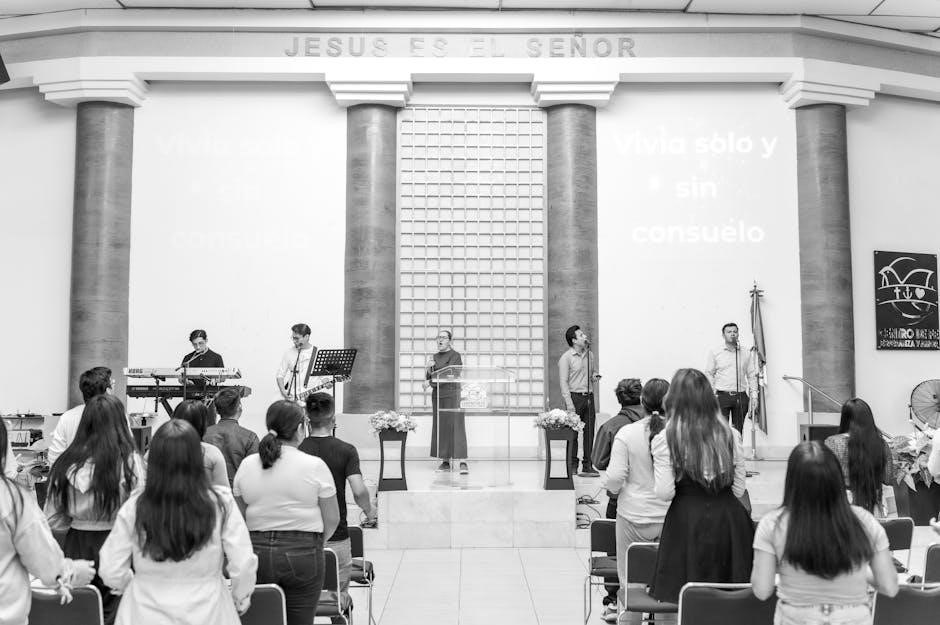
Connecting Clase 101 to Other Classes
Clase 101’s teacher’s PDF links to Clase 201 (spiritual maturity) and Clase 301 (discovering ministry), building a progressive path for member development.
Clase 201: Discovering Spiritual Maturity
Clase 201, building upon the foundation laid in Clase 101—often guided by a teacher’s PDF—focuses on deepening one’s faith and personal relationship with Christ. This course explores principles of spiritual growth, examining how believers can cultivate habits that foster maturity.
It delves into understanding spiritual disciplines, recognizing and overcoming spiritual obstacles, and developing a consistent prayer life. Rick Warren’s model emphasizes intentional growth, and the PDF materials likely outline practical steps for achieving it. The aim is to move beyond basic membership towards a life characterized by increasing Christ-likeness and impactful service.
Clase 301: Discovering Your Ministry
Clase 301, following Clase 101 and 201—supported by a teacher’s PDF—guides individuals in identifying and utilizing their unique spiritual gifts for service. This course emphasizes that every member of the church family has a vital role to play in fulfilling its mission.
It explores various ministry areas within the church, helping participants discern where their passions and abilities align with existing needs. Drawing from Rick Warren’s teachings, the PDF likely includes assessments and exercises to aid in this discovery. The goal is to empower believers to actively engage in meaningful ministry, contributing to the growth and impact of the church.
Practical Applications of Clase 101
Clase 101’s teacher’s PDF details practical steps like baptism, emphasizing the significance of the Resurrection and a believer’s commitment to the church family.
The Baptism Process
Clase 101’s materials, often found within a teacher’s PDF guide, thoroughly explain the baptism process as a public declaration of faith in Jesus Christ. This crucial step signifies a believer’s identification with Christ’s death, burial, and resurrection.
The course emphasizes baptism isn’t merely a ritual, but an outward expression of an inward transformation. It’s a commitment to following Christ and joining His church family. The PDF likely outlines the prerequisites for baptism, including a profession of faith and understanding of its spiritual significance.
It also details the practical aspects, such as preparation and the ceremony itself, ensuring candidates are well-informed and ready to participate meaningfully.
The Significance of the Resurrection
Clase 101, detailed in the teacher’s PDF, profoundly emphasizes the resurrection of Jesus Christ as the cornerstone of Christian faith. It’s presented not simply as a historical event, but as a transformative truth validating Jesus’s claims and offering hope for eternal life.
The course materials explain how the resurrection defeats sin and death, providing believers with the power to live a new life. The PDF likely explores the biblical accounts of the resurrection and its implications for daily living.
Understanding the resurrection is crucial for grasping the church’s purpose and the believer’s identity in Christ.

Resources and Materials
Clase 101 utilizes a student manual and teacher’s PDF, alongside downloadable transcriptions and module PDFs, facilitating a comprehensive understanding of church membership.
The Clase 101 Student Manual
The Clase 101 Student Manual serves as a core resource, guiding participants through the foundational principles of church membership. Often complementing a teacher’s PDF, it details the four-session structure, covering salvation through Jesus Christ, understanding the church family, defining church purpose, and commitment.
This manual aids in exploring the church as a spiritual family, emphasizing spiritual maturity and discovering individual spiritual gifts. It reinforces the importance of ministry commitment and provides a clear understanding of the church’s reason for existence and strategic fulfillment of its purpose. The manual is designed to be interactive, encouraging personal reflection and group discussion, ultimately preparing individuals for a meaningful commitment to membership.
Downloadable Transcriptions
Downloadable transcriptions of Clase 101 sessions, often accompanying the teacher’s PDF, provide a valuable resource for review and deeper understanding. These transcriptions, like those from Saddleback Church, offer a detailed record of the teachings on church membership, salvation, and spiritual growth.
They allow participants to revisit key concepts, such as the church’s declaration and strategy, at their own pace. Access to these materials supports diverse learning styles and ensures accessibility for those who prefer reading or require further clarification. These transcriptions reinforce the course’s emphasis on commitment, ministry, and understanding one’s role within the church family.
PDF Versions of Course Modules
PDF versions of each Clase 101 module, including the teacher’s PDF guide, are readily available for convenient access and offline study. These digital resources encapsulate the core teachings on discovering church membership, encompassing salvation through Jesus Christ and understanding the church family.
Modules detail defining church purpose, commitment to membership, and exploring spiritual gifts. The downloadable format allows participants to print materials or view them on various devices. This ensures flexibility and supports a comprehensive learning experience, reinforcing the course’s foundational principles and practical applications for spiritual maturity.

The Role of Leadership
Leadership, utilizing the teacher’s PDF, champions Clase 101, ensuring consistent delivery of core tenets regarding church membership and spiritual family commitment.
The Pastor’s Role in Membership
The Pastor, guided by the Clase 101 teacher’s PDF, is central to fostering a welcoming environment for new members. They articulate the church’s purpose and strategy, emphasizing the spiritual family aspect.
Their role involves championing the four-session course, ensuring consistent messaging around salvation through Jesus Christ, understanding the church family, defining purpose, and commitment.
The pastor’s endorsement of the Clase 101 curriculum, as developed by figures like Rick Warren, demonstrates a commitment to a structured onboarding process, promoting spiritual maturity and active ministry participation within the congregation.
Leadership Commitment to the Course
Leadership’s dedication to Clase 101, utilizing the teacher’s PDF, signifies a unified vision for church growth. Active participation demonstrates belief in the curriculum’s power to integrate new members effectively.
Commitment extends to resource allocation, ensuring the course is well-facilitated and accessible. Leaders champion the importance of understanding the church’s declaration and strategy, as outlined in the materials.
By embracing the Rick Warren model, leadership reinforces the value of spiritual maturity, discovering gifts, and committing to ministry, fostering a thriving church community through intentional discipleship.

Historical Context
Clase 101 originated with Rick Warren at Saddleback Church, evolving over time with updated teacher’s PDF materials to refine the membership onboarding process.
The Origins of the Clase 101 Curriculum
Clase 101’s roots lie within Rick Warren’s vision for Saddleback Church, aiming to systematically integrate new believers. The initial curriculum, often distributed as a teacher’s PDF, was born from a desire to move beyond traditional membership classes.
Warren sought a structured approach, dividing the course into four sessions, each approximately one hour long. This format, detailed in the PDF guide, allowed for comprehensive coverage of core beliefs and expectations. Early iterations focused heavily on salvation through Jesus Christ and understanding the church as a spiritual family.
The teacher’s PDF served as a vital resource, providing outlines, discussion points, and supplemental materials. It was designed to equip leaders to effectively guide participants through the foundational principles of church membership.
Evolution of the Course Over Time
Initially delivered via a comprehensive teacher’s PDF, Clase 101 has undergone refinements reflecting evolving church needs. Early versions, focused on foundational doctrines, expanded to incorporate discussions on spiritual gifts and ministry involvement.
The PDF materials were updated to include more interactive elements and address diverse religious backgrounds within the congregation. Subsequent iterations emphasized the church’s specific purpose and strategy, as outlined in the downloadable resources.
Digital accessibility increased, with PDF modules becoming available online alongside downloadable transcriptions. This evolution ensured broader reach and facilitated self-paced learning, while the core principles remained consistent, guided by the original Rick Warren framework.
Frequently Asked Questions
Frequently asked questions, often addressed with a teacher’s PDF, clarify membership expectations, baptism, and the significance of the resurrection within the church community.
Common Questions About Church Membership
Common questions surrounding Clase 101, often detailed in a teacher’s PDF, frequently concern the commitment required and the benefits of formal church membership. Individuals inquire about the baptism process and its spiritual significance, seeking clarity on its role within the faith. Many ask about the church’s specific purpose and strategy, desiring to understand how they can contribute meaningfully.
Others explore the diversity of religious backgrounds within the congregation, wanting assurance of inclusivity. Questions also arise regarding spiritual gifts and how to discover one’s unique role in ministry. Ultimately, prospective members seek to understand the church’s declaration and how it aligns with their personal beliefs.
Addressing Concerns and Misconceptions
A teacher’s PDF for Clase 101 proactively addresses common concerns. Some worry membership implies a loss of individuality, which is clarified as embracing a spiritual family. Misconceptions about required financial commitments are dispelled, emphasizing voluntary giving. Concerns regarding time commitments are addressed by outlining manageable involvement options.
The course clarifies that membership isn’t merely a formality, but a deepening of one’s relationship with Christ and the church community. It tackles the idea that spiritual maturity is a prerequisite, emphasizing it’s a journey fostered through involvement. Ultimately, the goal is to alleviate anxieties and foster informed commitment.

Future Developments
Clase 101 updates may include enhanced teacher’s PDF resources, expanded digital accessibility, and refined modules reflecting evolving church needs and member feedback.
Potential Updates to the Clase 101 Curriculum
Considering the evolving needs of congregations, future Clase 101 curriculum updates may focus on refining the teacher’s PDF guide. This includes incorporating more interactive elements and updated multimedia resources. Enhanced sections on baptism and the significance of the resurrection are also possibilities.
Further development could involve addressing frequently asked questions more comprehensively, and expanding upon the diversity of religious backgrounds within the church. The goal is to create a more engaging and accessible experience, ensuring the core principles of membership—salvation, church family, and commitment—remain central. A revised PDF could also streamline the leadership commitment section.
Expanding the Course’s Reach
To broaden the impact of Clase 101, utilizing the teacher’s PDF as a foundational resource, translation into additional languages is a key priority. Making downloadable transcriptions and PDF versions of modules readily available online will increase accessibility.
Furthermore, exploring partnerships with other denominations could extend the course’s reach beyond its current network. Developing a streamlined online version, compatible with various devices, is also crucial. Promoting the course through social media and church networks, highlighting its focus on spiritual maturity and discovering one’s ministry, will attract new participants.